跳转到主要内容

News & Updates

Ten Key Considerations for Equity Design in Asset-Light Companies

2022-03-18 Sunway Research

[Summary]A sound and well-designed equity structure is particularly crucial for companies planning to raise capital or those that have already done so. If the equity structure is not properly designed and arranged at the startup stage, it may create serious risks for future development, such as dispersed control, excessive dilution of the actual controller's stake after multiple financing rounds, inability to implement reasonable team incentives, and reduced efficiency in corporate decision-making. Based on practical project experience, this article compiles ten key points in equity design for asset-light companies for your reference.
logo分割标志

Preparatory Work — Framework Clarification

Equity structure design is a systematic project—a customized outcome achieved through the balance and integration of various elements. Therefore, before fully constructing the equity structure, it is necessary to analyze and categorize relevant factors such as people, capital, and business operations based on the actual situation. Only after identifying key elements can targeted measures be implemented.

(I) People

Label and classify the individuals involved in the company's early-stage establishment:

1.Actual Controller

First, determine who will lead the startup—that is, whose vision will dictate the company's development and strategic direction.

2.Founding Partners

Founding partners are members of the core team who collaborate with the actual controller. It is essential to understand their primary motivations and demands, which commonly include:

  • Viewing the startup as a promising business opportunity—while not deeply involved in daily operations, they expect their stake to reflect substantial financial returns; or

  • Treating the startup as a career—seeking an official role, participating in daily operations and management, and retaining a degree of decision-making authority.
    In reality, it is impossible to fully satisfy every expectation of all partners. Prioritizing the company's sustainable growth, the core demands of partners should be clearly defined.

3.Investors

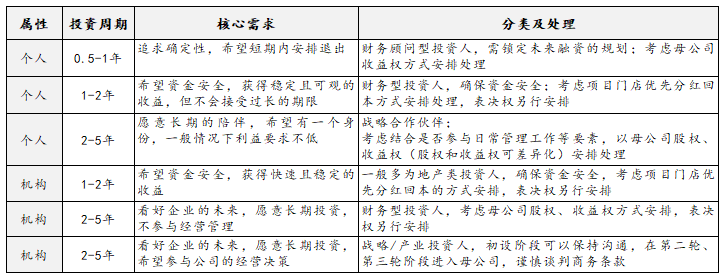
Investors should be labeled, categorized, and grouped—for example, classified according to the following principles:

4.Core Employees

This refers to key personnel recruited externally beyond the founding partner team, such as financial directors, sales directors, store managers, head chefs, technical consultants, etc. Based on their positions and roles, they should be categorized as either corporate-level management roles or operational-level management roles (e.g., single business unit/project/store).

5.Other Stakeholders

In practice, more complex situations may arise, involving parties such as channel partners, financial advisors, intermediaries, external technical consultants, etc. Their roles and core needs must also be clearly defined to facilitate coordinated efforts in establishing and growing the business.

(II) Capital

In simple terms, it is essential to determine "how much funding is required to launch this venture" and "who will provide these funds." To avoid the passive scenario of continuously seeking additional investment during the startup phase, reasonable and reliable financial projections are indispensable, with the development of financial models when necessary. Concurrently, the contribution amounts from each party and any funding shortfalls must be clearly defined to facilitate the arrangement of a financing timeline. During the financial modeling process, it is advisable to prepare three sets of projections based on 60%, 80%, and 100% achievement benchmarks.

(III) Business Operations

Clarify the core business activities of the startup—not merely a general operational direction, but a defined plan covering at least the next 1-2 years or even longer. This enables refined differentiation and handling during equity structure establishment, incorporating fiscal and tax considerations, thereby preserving flexibility for future tax planning.


Ten Key Considerations for Equity Design in Asset-Light Companies

(I) Foundational Principles

For startups with multiple business units/projects/outlets, the equity structure can be established using a "management company + project company" model:

  1. Management Company:

    • Typically functions as the parent company, holding core technologies, brands, trademarks, etc.

    • Oversees operations across all business units/projects/outlets through brand and technology licensing.

    • Focuses on continuous R&D and iteration of technologies or brands.

    • Serves as the primary entity for financing and capitalization.

  2. Project Company:

    • A subsidiary of the management company, dedicated to operating a single business unit/project/outlet.

    • Acts as the fiscal and tax implementation entity.

    • Responsible for cultivating and delivering qualified products, services, and operational teams.

(II) Equity Holding Structure & Arrangements

  1. Founder & Partner Holdings
    To ensure stable equity structure, founders and partners should hold shares at the management company level:

  • Founders: Direct shareholding

  • Partners: Direct shareholding or indirect holding through limited partnerships (LP), depending on their involvement in management.
    *Principle: Limit the number of direct individual shareholders (recommended ≤2-3 persons at startup stage).*

  1. Equity Incentive Reserve
    To avoid post-financing complications:

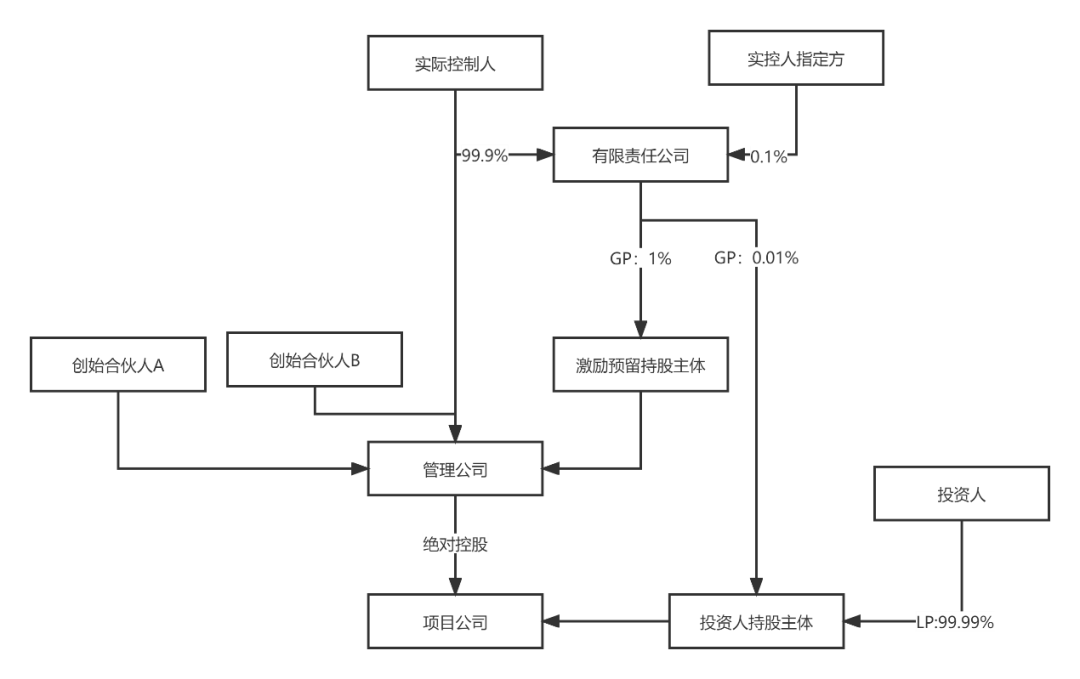
  • Reserve incentive shares in the management company upfront (typically structured as 1-2 LPs acting as holding platforms).

  • GP: Limited company established by the actual controller.

  • LP: Designated parties holding shares on behalf, forming an equity incentive pool.
    Rationale: Prevents dilution of current profits from share-based payments during financing rounds, mitigating tax/IPO risks.

  1. Project Company-Level Incentives

  • Reserve a portion of project company equity for core personnel (e.g., sales directors, store managers).

  • Held in trust by the management company; reclaimed upon departure and reallocated to successors.

(III) Registered Capital and Capital Contribution

In light of the revised draft of the Company Law, which significantly strengthens shareholders' obligations regarding paid-in registered capital and imposes joint liability on directors, supervisors, and senior management for supervising shareholders' capital contributions, the core principle should be to minimize registered capital in anticipation of future regulatory trends.

1. Management Company

  • Registered capital: RMB 1 million.

  • Additional capital contributions: Any amount exceeding the registered capital shall be recorded in the financial statements as shareholder advances.

    • For advances by the actual controller: Consider retaining the right to convert into equity (e.g., under certain conditions, the actual controller may opt for conversion in the future).

    • Note: Equity conversion may raise concerns among investors and must be properly addressed before financing (e.g., converting into registered capital via capital reserve).

2. Project Company

  • Registered capital: RMB 500,000.

  • Additional capital contributions (especially from investors): Treated as shareholder advances.

    • Rationale: Since most project company investors derive returns through dividends or equity swaps with the parent company, structuring excess capital as shareholder advances allows tax-free dividend distribution on such amounts.

3. Special Agreements (If Applicable)

  1. Over-budget investment in project companies:

    • The shortfall shall be covered by the management company via shareholder advances, with priority repayment from future dividends.

    • A supplemental shareholder resolution must be issued to formalize this arrangement.

  2. Sustained losses in project companies:

    • Shareholders may decide whether to continue operations or liquidate.

    • Shareholder advances shall be subject to special waiver in such cases.


(IV) Equity Structure Framework

(V) Decision-Making Mechanism

In the early stages of a company's establishment, the decision-making process should be as straightforward as possible—essentially following the principle of "the actual controller has the final say."

Particularly regarding management and financial decisions, authority should remain concentrated with the actual controller. Therefore, in the initial phase, it may be unnecessary to establish a board of directors or board of supervisors. Instead, the actual controller can serve as the executive director, with the supervisor appointed by the actual controller. This ensures efficient planning, execution, and implementation of operational and managerial decisions. Even during later stages when institutional financing is introduced, efforts should be made to maintain management's efficient decision-making power over routine matters, reserving collective deliberation only for major strategic issues.

(VI) Equity Incentive Mechanism

  1. Equity Holding Platforms
    Equity holding platforms should be differentiated based on the attributes of the incentive recipients. In essence, distinct categories of recipients should be grouped under separate entities to uniformly address each class. For instance, classifications may be made according to:

  • External partners, investors, and senior executives; or

  • Technical personnel, channel partners, senior management, etc.

  1. Incentive Instruments
    During the initial phase, the incentive structure should primarily utilize options and profit-sharing rights. Even if actual equity is granted, it is imperative to ensure unified voting actions. The specific incentive plan may be separately designed and refined as the company progresses in its development.

(VII) Control Rights Lock-in Mechanism

1.Management Company Level

The core objective at the management company level is to ensure the founding team/founders maintain absolute control while preserving flexibility for future capital financing. Key considerations include:

1)Execution of voting agreements between founding partners and the controlling shareholder to ensure aligned actions;

2)Placement of external partners and other less controllable elements as limited partners (LPs) within equity incentive platforms;

3)During the startup phase, it is advisable for investors (especially individual investors) to hold equity uniformly as LPs in limited partnerships.

2.Project Company Level

The underlying principle remains consistent—ensuring the management company's absolute controlling stake—with the following distinctions:

1)To accommodate the liquidity of incentive equity, such shares may be held under nominee arrangements rather than through separate equity platforms;

2)Institutional investors or minority individual investors may hold shares directly, provided they enter into voting agreements. In all other cases, placement within equity platforms for unified management is still recommended.

(VIII) Capital Operation Model

The primary approach centers on financing at the management company level + single-project financing, including equity financing (for both the management company and individual project companies) and equity-debt hybrid arrangements (with tax planning considerations):

  1. Given the challenges in early-stage valuation and the general advisability against setting excessively high valuations, it is recommended to prioritize project company financing first (typically applicable when project companies demonstrate strong cash flow), followed by management company financing.

  2. During financing, consider equity-debit hybrid structures or debt financing, implemented through mechanisms like priority dividend distributions from project companies’ cash flow returns.

Core Principle: Ensure the stability of the management company's equity structure (with sufficient flexibility to undergo multiple financing rounds) and a rationally designed valuation trajectory, while maintaining the management company's controlling stake in project companies.

(IX) Project Company Financing and Dividend Distribution

  1. During the financing process, priority dividend clauses may be established to ensure initial investors recover their capital first. This must be implemented in conjunction with the project company's financial model, requiring investor consensus and acceptance of the valuation.

  2. After achieving breakeven, capital recovery through priority dividends should follow this sequence:

    • Premium investment amounts beyond registered capital (recorded as shareholder advances, with explicit waiver clauses in investment agreements to exempt repayment obligations in case of losses);

    • Registered capital portion;

    • Profit portion.

  3. Post capital recovery, dividends shall be distributed according to equity ratios. In special circumstances—such as specific projects requiring additional compensation for investors or incentive recipients—supplemental dividend rights may be granted to achieve:

    • Additional incentives/returns;

    • De facto differential voting rights (while maintaining nominal voting alignment), effectively creating a "same shares, different rights" structure through adjustable dividend rights.

(X) Future Arrangements

For certain projects, special arrangements may be considered for project company investors:

  1. Project company investors shall be granted priority rights to participate in subsequent project company investment rounds;

  2. Investors who consecutively invest in two or more projects may become eligible for inclusion in the management company's equity incentive pool. The specific calculation methodology shall be determined separately (it is recommended not to predetermine conversion formulas at this stage, given future variability - a reserved mechanism shall be established and finalized based on actual financing circumstances when needed).

Note: The currently effective Company Law does not include provisions for dual-class shares (different voting rights) or AB share structures. However, Articles 157 and 158 of the revised draft Company Law introduce new provisions for class shares in joint-stock companies, including shares with special voting rights and preferred shares.

While this key points list primarily references the currently effective Company Law, it will partially incorporate trends from the revised draft to make corresponding adjustments.


Applicability

This checklist primarily targets asset-light operating companies. Our firm has provided continuous services to smart retail companies, medical technology firms, beauty brands, F&B brands, and offline trendy toy brands during their establishment and financing phases. These asset-light companies share several common characteristics at inception:

  1. Multiple planned business units/projects/outlets;

  2. Founders with access to willing investors (both individuals and institutions);

  3. Channel partners and suppliers willing to collaborate;

  4. Awareness and demand for equity incentives and tax planning.

These commonalities also give rise to typical founder pain points during the startup phase:

  • Equity structure design: Poorly structured equity may lead to control disputes or excessive founder dilution;

  • Investor integration: Determining appropriate investment vehicles and balancing investor/company interests;

  • Equity incentives: Structuring plans for technical cores, executives, management teams, and channel partners;

  • Controlled expansion: Ensuring sustainable growth of business units/projects/outlets through prudent financial leverage.

This checklist specifically addresses these pain points with actionable solutions.


Conclusion

The framework analysis and key considerations for equity structure design outlined above often determine how far a company can go. In practice, more complex factors may need to be incorporated into a unified planning and evaluation process. Additionally, a customized equity structure design requires not only comprehensive elements but also legally binding agreements to implement and secure the arrangements.

Equity structure design is not one-size-fits-all. As laws, regulations, industry policies, and regulatory trends continue to evolve, the equity structure must also be adjusted accordingly to keep pace with the times.

end
Company Profile